
RETRO REBOOT | Dig Dug's Basic Design Is GAMING BRILLIANCE (Arcade)
Tunneling and monster busting
RETRO REBOOT
'ColonelFancy" Mike Lind
6/30/20262 min read
Developer: Namco
Published by: Atari
Released date: 1982
Like many arcade classics that shaped video games to what they became, there's little that I can say about Dig Dug that hasn't been published in the past. Its straightforward gameplay made it one of the perennial quarter-munchers of the time period. I had my first experience with Dig Dug on the Atari 2600, and it was a decent port. Perhaps a little imprecise with the inputs, but otherwise I found it to be a pretty stimulating game that I would enjoy.
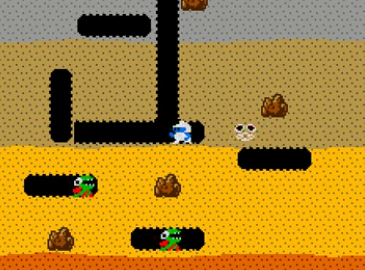
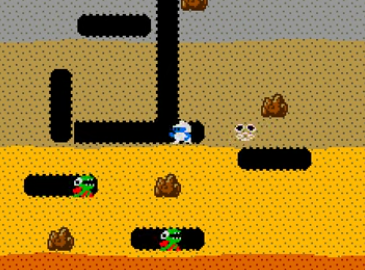
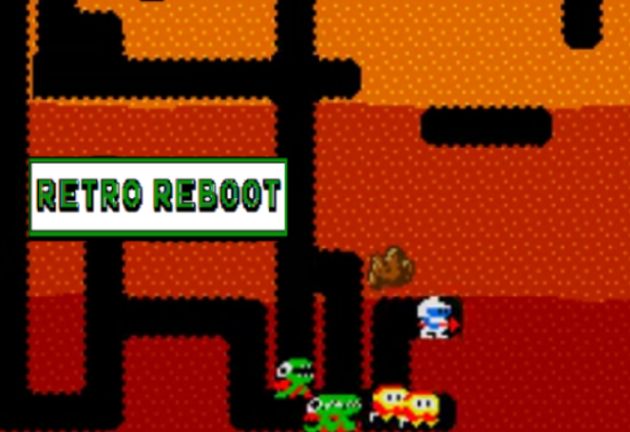
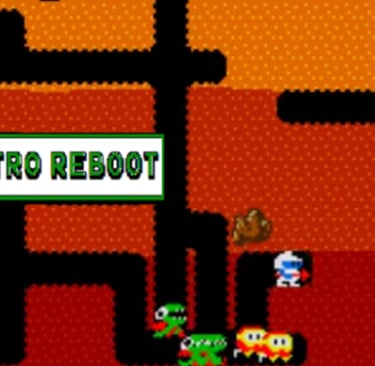
And yet, in Dig Dug's simplicity lies a handful of fundamental rules that makes the ebbs and flows of video games enticing when it comes to stage layout and rules enemies follow contrast to the protagonist. Taizo Hori can dig and travel in only four directions. Yet the monsters can become ghosts and circumvent those rules to get to you faster by phasing through the rocks you have to dig through.
This changes how you aim to not only stay alive by dropping rocks on their heads or pumping them full of air, but how to attack them to gain a higher score. means of changing the way you approach situations and traverse your area creates great spatial awareness that pop up in various games throughout eras. Very much like how some SHMUP titles will allow enemies' bullets to go through walls. Your craft cannot touch such obstacles, so you have two hazards to avoid.
And there's only two enemies, Pookas and Fygars. Pookas will be designated to have one chase you, while another one will spend half of the time avoiding you. Fygars can breath flame, giving you a projectile that you have to avoid. Again, basic things that have an affect on how you're choosing to evade and attack. Going to a game like Castlevania, where you traverse levels with mostly the ability to shoot directly in front of you, while robots attack from angles where you can't particularly aim. And rules on what enemies can go through or shoot through walls. These basic guidelines are what sharpens your ability to improve and hone your skills of evasion and offense, even If you're not aware of it. To me, that is the fundamental building block of brilliant game design. Most of Namco's arcade classics established those philosophies, and they would be an integral part of programming and directing.
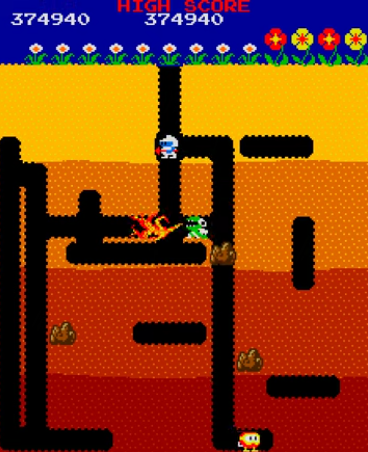
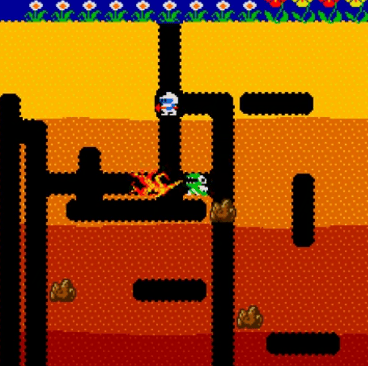
Dig Dug's layout doesn't change, beyond where the monsters start and the colors of the ground, I like to map which ones I aim to take out first. I forget which point it hits where the layouts begin looping. I think the highest I've ever reached when seriously playing is 52. It makes me want to go back to practicing to see how far I can reach before hitting that ceiling. While I always preferred arcade games like Burger time a little more than Dig Dug, this one is still a hell of a lot of fun.