
RETRO REBOOT | Resident Evil 2 (Sony PlayStation)
Tank control perfection (almost)
RETRO REBOOT
"ColonelFancy" Mike Lind
5/6/20266 min read
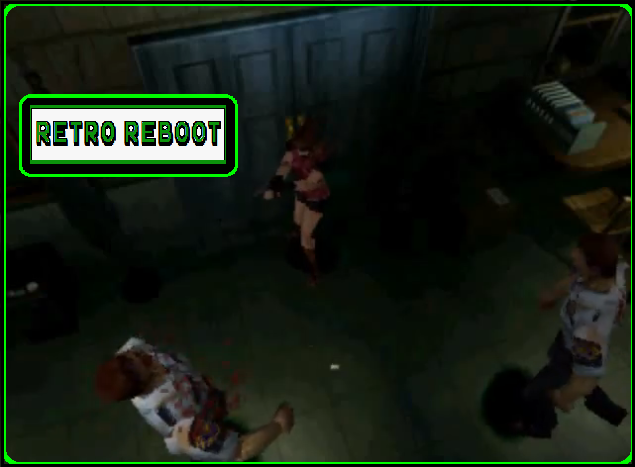
Developer: Capcom
Published by: Capcom
Release date: January 21st, 1998 (US), January 29th, 1998 (JP)
Well, gosh darnit. Up until the release of the Resident Evil 2 Remake, RE2 on the PlayStation was my favorite entry in the series. Taking advantage of their RE Engine, it made significant enhancements narrative wise to the original game's story, the puzzles, and the design of the police department. The OG RE2 was quite groundbreaking for its time. Visual techniques on the PlayStation were getting better, and by 1998, since the Sega Saturn was on its deathbed in the United States, I finally gravitated to the PS1. Games like RE2 did not disappoint.
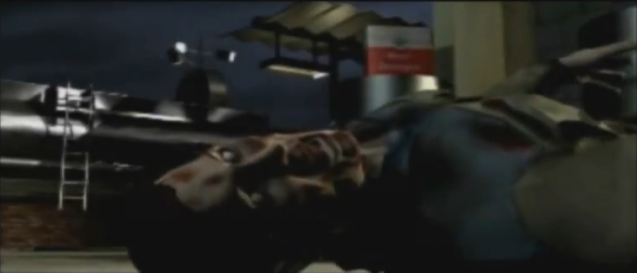
The opening movie sets the pace for this game, letting the player know that the stakes are that much bigger. It is probably the one of the best, and more memorable opening cinemas, not just on the console, but in gaming altogether. CGI was gaining some ground at this time and images were sharper and moved with more fluidity. The decision to use computer models instead of returning to the cheesy as all hell live actors, though I gotta say, it certainly had its charm.
The FMV allowed to set a new tone that probably could not have been done without some serious financial backing and probably better actors. The mood escalates into a crescendo as the rampage and carnage starts when we are introduced to our two protagonists, Leon and Claire. As the truck explodes and the two are split up by the wreckage, you are literally thrown into the fire as a maelstrom of zombies will overwhelm you immediately. Other games have tried to light that fire under you to get you geared to play it shortly after the introductory cinema (Crysis 2, Bio Shock, Devil May Cry, to name a few), but this is still probably the best on the market that is only rivaled by Metal Gear Solid.
Resident Evil 2 pushed some serious limits with its young console (okay, three years old isn’t very young in hardware development terms) with amazing graphics and detailed backgrounds. The first game kept you cooped up inside the mansion for a good majority of the run, but now you are thrust into the decaying ruins of Raccoon City. The static, hand-drawn layout is lush with detail, from scattered desktops, blood-stained walls, alleyways littered with garbage. In an age when seldom a game tried to boast real-time detailed environments (still looking at you, Ninja), this practicality was a part of Resident Evil’s early charm as well.
One of the more vital introductions in this game was visual damage. You on longer have to routinely open the menu to see how low your health is, Leon of Claire will clutch their side or limp badly. I can’t recall how many times I died in the first game because I thought I was fine.
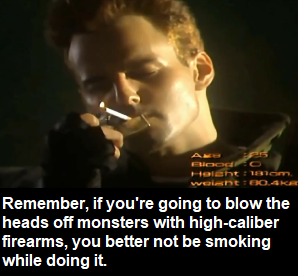
Leon or Claire will also look in the direction of on-coming monsters or stare at fallen zombies playing…uh..dead (that was unavoidable). A clever addition that helped out greatly when approaching a corner you couldn’t see around and kept you from walking blindly into a pack of undead or a Licker.
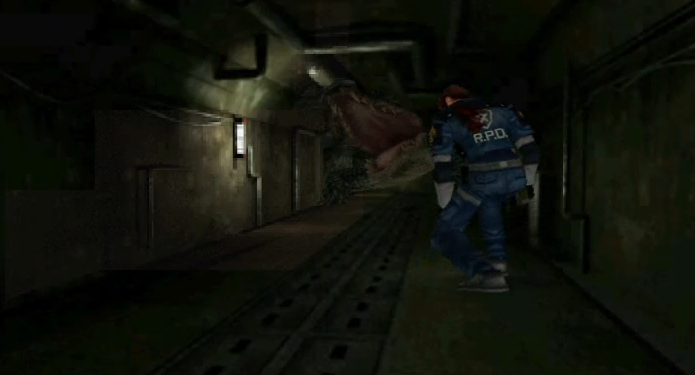
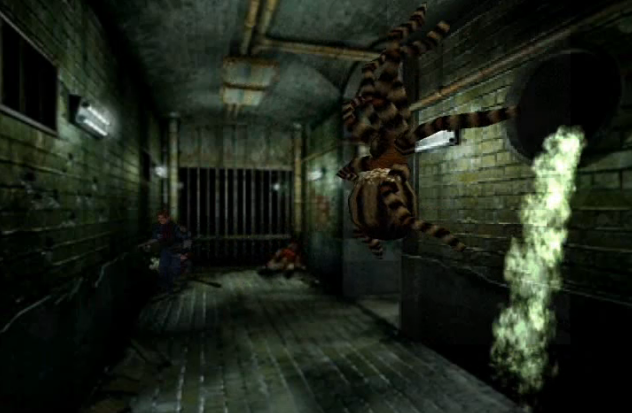
RE2 also introduced a wider variety of zombie models. Policemen, women (undead equality and all. Who said a lady can’t be a flesh-eating monster? Ask Amber Heard.), and cadavers from a morgue. The super popular Lickers make their debut here as well and these terrifying creatures are agile and deadly. I didn’t know that Voldo from Soul Calibur had offspring.
The camera doesn’t really block you view too often and cuts from scene to scene never leave you feeling disoriented as often as in the first game, and the locations never feel repetitive. Jump scare moments, like the hands reaching through the boarded up windows in the police station, are earned.
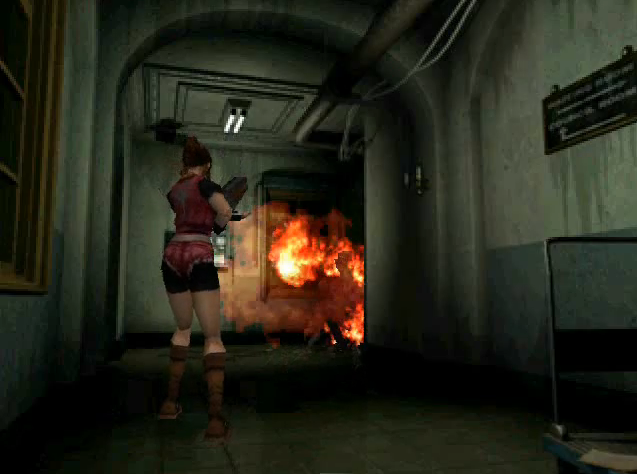
Music production is top-notch and is sweet on the ears. Resident Evil’s eerie themes always keep you on your toes. Just as well, the game’s sound effects can also be greatly praised. Off screen enemies can be heard around corners and it’s easier to judge how far they are away as they approach. It is often a sigh of relief when entering a new room and discovering a safe spot and the safe room theme plays before the screen boots up.
Voice acting is still a bit cheesy, but not because of the performers, but rather the script is littered with hokey lines. It’s far and few in between and a vast improvement over the previous game, whose cutscenes and dialogue are legendary for how goofy it is. Stephanie Panisello does a great job with the role, but Alyson Court is still my defacto Claire Redfield.
The tank controls are polished and a little sped up in this game, making for a much-improved playing experience. Aiming is quicker and you have a wider variety of weapons to choose from. Not to keep harping on this fact, but dammit, I missed back when these games taught you how to rationalize your inventory. In my first couple of go-arounds with this game, I blew all of my ammo early and was stuck relying on the knife. It wasn’t until I properly learned tactical evasion and conservation that makes RE5 and 6 so damn stupid because when dealing with a survival horror concept is learning how intelligently utilize your ammunition.
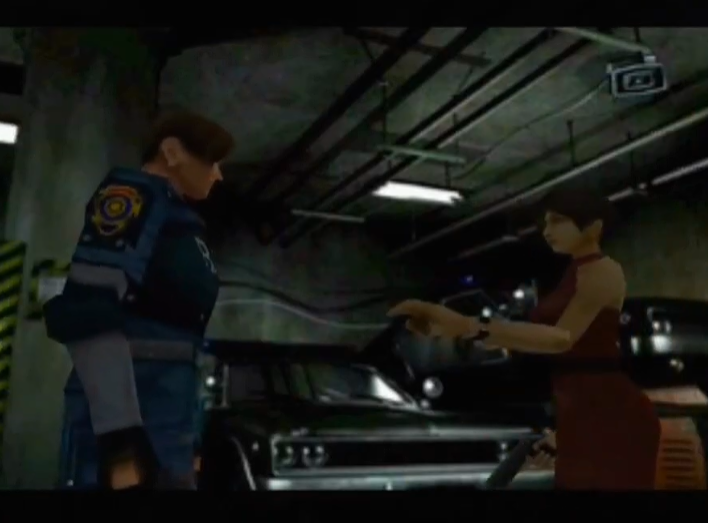
RE2 amps up the challenge a little bit, and it’s a little more than just throwing more zombies in your path (there’s a lot of zombies). The puzzles are still within the same spirit, what with concepts that are right out of the middle ages; various keys with silly themes that open certain doors, crests that need to be put into reliefs to open trap doors. I always just assumed that they were there for the sake of a puzzle, and nobody wants to travel throughout the entire game repairing fuse boxes, but it’s the twentieth century and someone took the time to create these archaic structures to hide a map or grenade launcher rounds? Perhaps this is just an element of the early games that are taken for granted, but it’s not that hard to see why Umbrella fumbled this whole operation.
At the very least, the backtracking isn’t as boneheaded. Riddles can be solved by remembering certain pieces of text or key sentences from a manuscript, and are generally in close proximity to the location you are trying to reach. Oddly enough, I think the R.C.P.D. Headquarters is easier to navigate than the Arkley Mansion, perhaps the long hallways feels a little more simplified than the tight foyer rooms and corridors. Choices also pop up that can have an unforeseen effect on the path you travel. You will come across a cord that can close shutters on two sides of the police department. Either way, a pack of zombies will get in, regardless of which circuit board you fix, so which one do you shut down? The multiple playthroughs and the extras, like Hunk, Meat, and Ada’s mode, are where the difficulty really picks up.
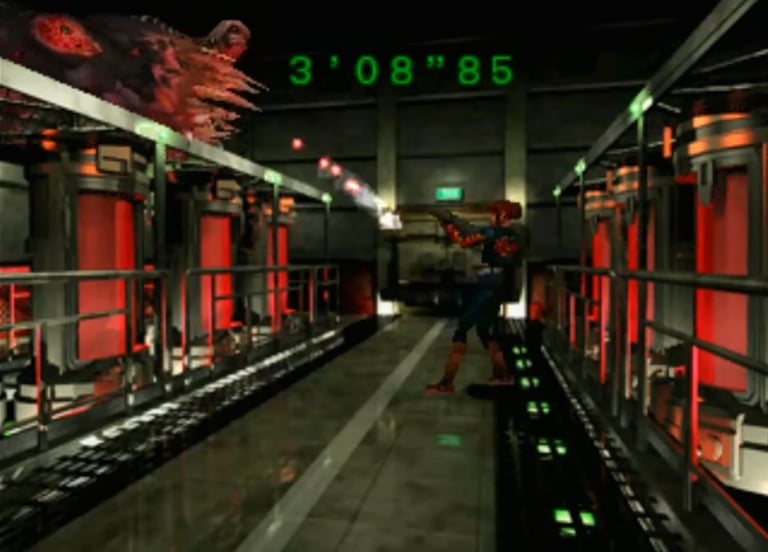
Speed runs and going through the game without picking up or using healing items are adrenaline-pumping side quests, and while really difficult, it’s a blast to unlock the extras for achieving these feats.
While the Remake legitimately outclasses it, there's still a soft spot in my heart for Resident Evil 2. The solid story that picks up off the first game, the new enemies, escort-style missions with Sherry and Ada (both were very good), crisper controls, memorable moments like the alligator battle (brief, but heart-pumping) a wide array of extras, establishing some of the franchise's most endearing characters, and its high replay value make this the most complete game in the series for the time period.